The missing link was the real incident
At 11:17, a doctor reviewing an IVF chatbot answer asked why the progesterone link had disappeared.
The answer looked reasonable. The missing source did not. No alert had reached the clinic team. Nobody knew that a useful next step had been removed before the patient saw the reply.
The clinic had not deleted its progesterone page. An old chatbot rule had removed the link because the same URL appeared under more than one label.
That rule had a sensible origin. An earlier bot had repeatedly sent one page for unrelated questions. The quick fix was to reject any link used across multiple labels. Later, the model improved at judging relevance. The blanket rule stayed until it was removed as a reviewed change.
This is the failure your chatbot review is least likely to find. The answer you can read may be acceptable.
A polished answer can hide a failed handoff
Most clinic chatbot reviews begin with visible conversations. Someone checks WhatsApp replies, looks for unsafe medical claims, tests the tone and confirms that the bot can hand a patient to a person.
Those checks catch obvious failures. They do not show the decisions made between drafting and sending.
A patient message may pass through several controls. The patient asks a question on WhatsApp. The chatbot retrieves possible clinic sources and drafts a reply. A quality filter checks whether the reply should be sent. The filter may remove a link, hold the entire answer or send only part of it.
The clinic sees the final conversation. It may not see the decision in the middle.
That decision can be sensible. A reply containing an invented URL should not reach a patient. A question about diagnosis, treatment suitability, a complaint or an urgent symptom may need a human. A refusal that gives no useful next step is not a successful handoff.
The operational failure is different. If the clinic cannot see what was held back and why, it cannot correct the rule, source or model behaviour.
That matters in Indian specialty clinics because WhatsApp is often the first patient channel. A family member may ask about IVF preparation, a dental procedure page, an eye-care eligibility detail or an orthopaedic consultation. If the reply becomes generic, the patient may stop responding before a two-to-five-person front desk knows that a serious enquiry existed.
The money does not appear as a failed campaign. It appears as no booking, no callback request and no task for the front desk. For mostly out-of-pocket procedures, the gap reaches revenue directly.
Public tests make the same point from another angle. A CustomerThink report published on 13 November 2026 found that only four of 68 company chatbots answered three basic visitor questions. The visible reply is already a weak measure of quality. It says nothing about answers that were drafted, rejected and forgotten.
Review the reply the patient never saw
You do not need a large quality team. You need one named owner and one review queue.
That owner might be the patient-experience lead, operations manager, marketing head or doctor who already approves patient-facing content. The owner should not read every WhatsApp conversation. They should review cases where the system made a decision that needs judgement.
- Open the held-back record. Read the patient’s original message, the complete drafted answer, the link decision and the plain-language reason. “The AI was unsure” requires a different response from “the link could not be verified.”
- Classify the failure. Decide whether the source was missing, outdated, irrelevant or rejected by mistake. Also decide whether the patient genuinely needed a person because the question involved diagnosis, treatment suitability, a complaint or an urgent concern.
- Correct the source or answer. Add the approved clinic page, remove an outdated page or write the response the bot should use. Keep medical claims within approved guidance. Check regional-language wording when patients use Hindi, Marathi, Tamil, Bengali or another language on WhatsApp.
- Assign the next owner. A medical question may need a doctor. A booking question may belong to the front desk. A changed fee, doctor profile, offer, camp date or timing may belong to marketing or operations.
The correction must enter the approved chatbot knowledge, not remain in a private message between a vendor and one staff member. Otherwise, the same missing link can return after a model update or rule change.
Give the queue a service rule. A booking or payment question should not wait behind a content review. An IVF patient asking about preparation may need a careful human response, not an automated correction. A wrong doctor timing can be fixed by operations, but only after someone confirms the current schedule.
This is also where patient safety and DPDP-minded operations meet. The review record should contain only the information needed to understand the interaction. Access should be limited to authorised staff.
Source monitoring catches quiet website changes
There are two separate things to watch: what the bot says and what it is allowed to use.
A clinic website changes constantly. Doctors join or leave. Fees change. A fertility page gains new preparation instructions. An eye hospital updates timings. A dental offer expires. A page disappears after a redesign. If the chatbot keeps an older source, it can answer confidently from information the clinic no longer approves.
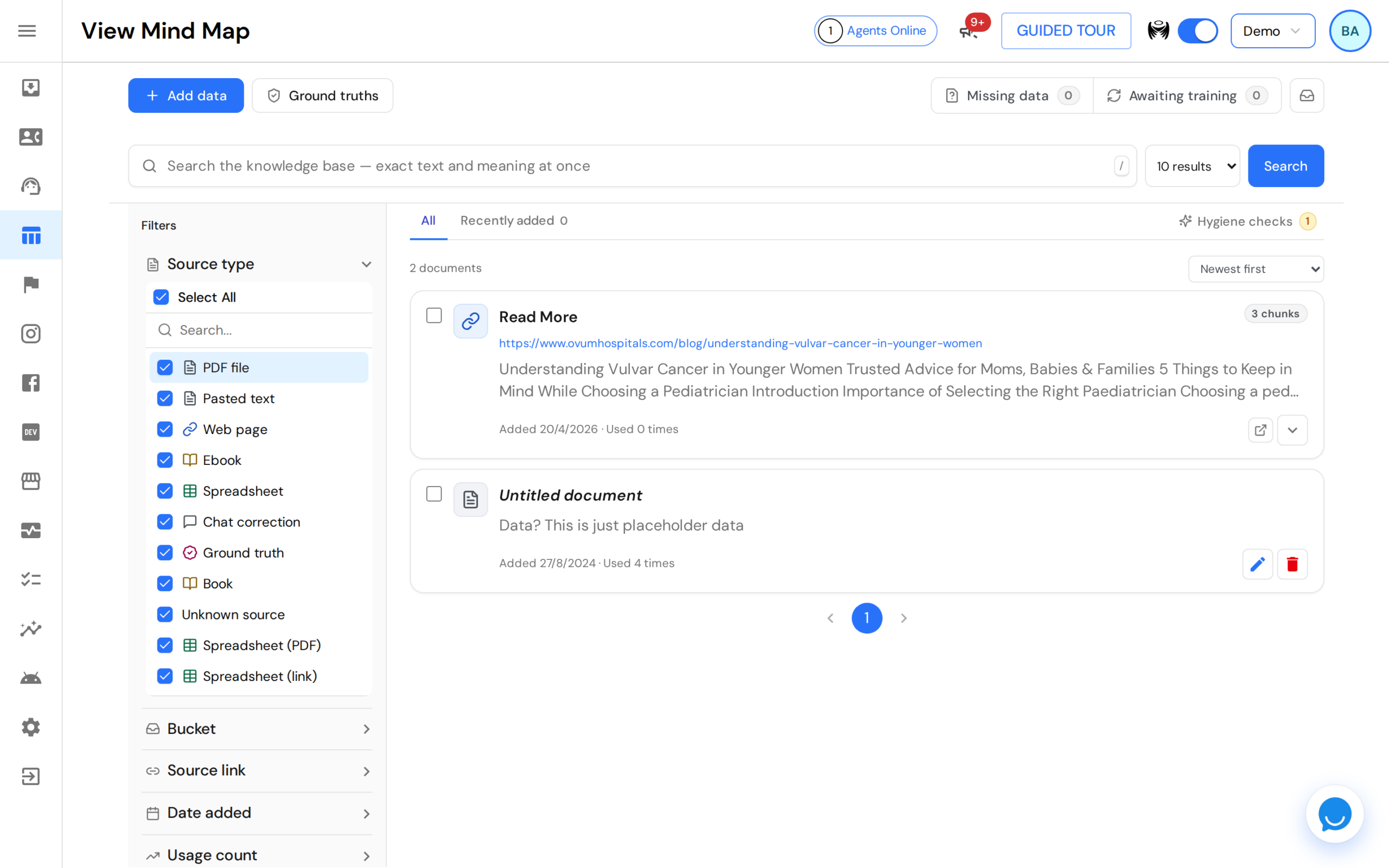
This is why a knowledge base should be a curated list, not a loose collection of scraped pages. Each entry should identify its source type, source link, date added, usage count and review status. Useful source types include web pages, pasted text, PDFs, chat corrections and approved ground-truth records.
Website monitoring should watch a filtered list of the clinic’s own pages. It should record which pages are new, changed, deleted, processed or failed during each scheduled run. It should not silently rewrite the website or decide that a changed medical page is automatically approved.
That distinction matters for NABH-minded operations. The clinic remains responsible for approving patient-facing information. The technology should make changes visible, keep an audit trail and limit access to authorised staff. It should not turn a content change into an unreviewed clinical instruction.
Source monitoring also helps explain why a chatbot is not linking to your website pages. The page may still exist, but the bot may have rejected its URL as unverified. The page may have changed since the last knowledge update.
| What you observe | Likely cause | What the clinic should inspect |
|---|---|---|
| The answer has no link | The link was removed or the reply was held | Suppression reason and drafted reply |
| The wrong clinic page appears | Old or weak source selection | Approved source list and usage history |
| The page is current but never used | Source is missing, unprocessed or marked for review | Knowledge entry and processing status |
| The page changed without a chatbot update | Website content moved ahead of review | Content-change report and page owner |
Run one suppression audit this week
Pull your chatbot’s last 30 days of suppressed replies. Count how many records include the patient message, the drafted answer, the reason and the source decision. If your vendor cannot show those four parts, treat the control as incomplete.
Review five records from the questions your clinic actually receives. Include a booking request, a treatment-information question, a page-link request, a regional-language message if relevant and one case that should have reached a human.
For each record, ask one operational question: could a named staff member correct this without developer support?
If two or more of the five cannot be explained or corrected, pause new chatbot content changes and fix the review path before adding more automation. Ask BeyondChats to show you its managed suppression monitoring and curated source management for your clinic’s chatbot, then decide whether that visibility is enough for your team.